Overflow
Water spilling over the edge can point to blockage, poor pitch, or insufficient capacity.

Family-owned · More than 20 years
Seamless gutters, downspouts, and protection options sized and placed around the roof and property.

What we handle
A gutter system works best when the runs, outlets, downspouts, rooflines, and discharge points are considered together.
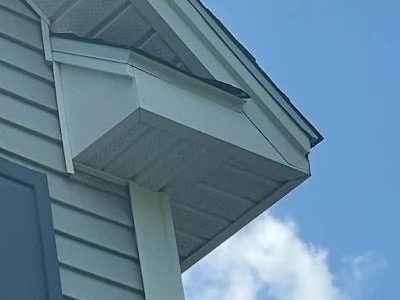
Warning signs
Water spilling over the edge can point to blockage, poor pitch, or insufficient capacity.
Loose fasteners or damaged fascia can leave runs sagging and misaligned.
Downspouts should carry runoff to a sensible point away from the structure.
Getting it right
Most gutter complaints are not about the gutter. They are about how much water arrives, how fast it leaves, and where it ends up.

Connecticut winters
Anything holds water in July. What separates a working system here is how it behaves through a freeze-and-thaw cycle.
Snow melts higher on a warm roof, runs to the cold eave, and refreezes. The gutter did not cause it, but a blocked or overflowing one makes the backup worse.
Ice is heavy. A run already sagging on tired fasteners or soft fascia is the one that comes away in February.
Leaf protection reduces debris and the cleaning that comes with it. It is worth having, and it is not an ice-dam cure — anyone selling it as one is overselling.
Clearing before the first freeze does more than clearing after it. Debris left in the trough holds water exactly where you least want it to freeze.
Common questions
Sometimes. But if they overflow when clear, the cause is usually capacity or too few downspouts for the roof above. Cleaning a system that is undersized will not fix it for long.
Under heavy tree cover, generally yes — they cut down how often the system needs clearing. They reduce maintenance rather than remove it, and they will not stop ice dams.
It depends entirely on the trees around the house. What matters more than a schedule is getting it done before the first hard freeze, so the trough is not holding water when the temperature drops.
Often, yes. Loose sections, leaking joints, damaged outlets, and lost pitch are all repairable. Replacement makes more sense when the runs are undersized for the roof or the fascia behind them has gone.
It is usually the sensible sequence. Drip edge, flashing, and the gutter all meet at the same line, and handling the roof and the drainage together avoids disturbing new work later.
We serve 69 communities across western and central Connecticut, grouped across Litchfield, Hartford, New Haven, Fairfield, and Middlesex counties. You can check the full list of towns and call to confirm service for your address.